Jensen Huang is back: what Nvidia’s rebound means for your pension
Opinion and market commentary · 24 November 2026
Written by Sam Mather-Holgate, Mather & Murray Financial. General information, not personal investment advice.
The leather jacket is back at the top of Nvidia. Investors have already cheered. The harder question is whether your financial plan needs to change.
Jensen Huang’s return is the sort of corporate reversal that makes a trading screen look like a scoreboard. After a bruising period for AI shares, the prospect of familiar leadership has given investors something tangible to welcome. Donald Trump is claiming a role in the turnaround. There is relief, political theatre and a great deal of money moving at speed.
For someone watching a pension or ISA, the temptation is to ask whether this is the moment to jump back in. Our view is that a more useful question comes first: how much of your future already depends on this corner of the market?
What has actually happened at Nvidia?
Nvidia confirmed on 23 November 2026 that Huang had been reinstated immediately as president, chief executive and a board director. Colette Kress continues as chief financial officer after serving as interim CEO.
The company’s announcement also says its independent investigation will continue and describes additional compliance oversight. His return is therefore a leadership decision, not a declaration that every outstanding question has disappeared.
Reuters reported on 23 November that Nvidia shares rose around 31% during Monday’s trading and the Nasdaq rallied more than 6%. Trump said he had secured a deal for Huang’s return. Those are dated reports of Monday’s reaction, not forecasts for today or closing-price guarantees.
Trump can claim the credit while investors ask for the evidence
Political leaders rarely allow a rising stock market to pass without comment. In this case there is a documented link: Nvidia says senior US government input informed the board’s assessment of national-security risk. That supports taking the political involvement seriously. It does not establish that one intervention explains every share-price move.
Our interpretation is that a change in confidence can move prices much faster than a change in a business’s underlying economics. Restoring a prominent leader may reassure customers, staff and shareholders. It cannot, by itself, tell us what future earnings are worth.
That distinction matters. A compelling comeback is a story. A durable investment return still needs the numbers to support it.
Could this mark a lasting AI market recovery?
It could become part of one, but a strong session cannot settle that question. Our positive scenario is straightforward: leadership uncertainty fades, businesses continue finding profitable uses for AI, and investment spending produces sufficient earnings to justify expectations.
The less comfortable scenario is that enthusiasm runs ahead of the returns. The investment questions we would watch include how customers finance spending, what they earn from it, competition, export restrictions and the price investors are paying for future growth. These are questions for assessing risk, rather than claims that a particular outcome is inevitable.
We are open to the optimistic case. AI can be commercially important without every AI-linked share being attractively priced. Equally, a volatile fortnight does not prove the technology has failed. Investors need room for both possibilities.
Why UK pensions and ISAs can feel a US technology story
A pension or ISA is a wrapper, not an investment strategy. Its exposure depends on the funds, shares and other assets held inside it. A global fund, a US equity fund and a technology fund may have overlapping holdings. Several fund names do not necessarily mean several independent sources of risk.
For illustration, suppose three funds each represent one-third of a portfolio and each has 6% in the same company. The combined exposure to that company is still 6% of the portfolio. The calculation needs the actual fund weights and holdings, not a count of how many funds you own.
The FCA explains why diversification matters. Spreading investments can reduce reliance on individual holdings; it cannot eliminate losses. For UK investors holding unhedged overseas assets, currency movements can also affect the sterling result. Your return may differ from the dollar headline.
A rebound does not necessarily repair a fall
Here is a simple illustration, not Nvidia’s price history: an investment falling from £100 to £70 loses 30%. A subsequent 30% rise takes it to £91, not £100. A sharp recovery can feel decisive while leaving a portfolio below its previous value.
That is why we would judge a portfolio against the money it needs to provide and the risk its owner can afford, rather than against the excitement of a single session.
Five questions worth asking about your own portfolio
- What do I actually own? Look through the funds to identify overlapping company, sector and country exposure.
- When will I need this money? A near-term withdrawal and a retirement many years away create different planning needs.
- Could I cope with another fall? Consider its effect on spending and retirement plans, as well as how it would feel.
- Does the portfolio still match the plan? Review risk, diversification, charges and the purpose of each holding together.
- Am I reacting to a headline? Buying, selling or doing nothing should follow a considered decision, rather than fear of missing out.
For people approaching or taking retirement income, the conversation also includes withdrawals, cash needs and how different sources of income fit together. Our options at retirement page explains the wider choices.
What should investors do after Nvidia’s rebound?
There is no single action that suits everyone. Huang’s return may prove an important turning point for confidence. It is not a personal recommendation to buy Nvidia, sell a fund or move a pension.
Our view is that this is a useful prompt to understand your existing exposure. If you cannot explain why your portfolio is built as it is, that is a better reason for a review than a dramatic market headline.
Want a clearer picture of your pensions and investments?
Mather & Murray Financial helps clients across the UK, including Swindon, Cirencester and the wider region. We can discuss whether a pension and investment review is appropriate, including your objectives, risk, existing arrangements and charges.
Ask about a pension and investment review
Your first conversation is with our new business team and is free and without obligation. Personal advice is a separate service; its scope and any fees are explained before you commit. A review does not assume that moving your investments is the right outcome.
Quick answers
Is Jensen Huang back as Nvidia CEO?
Yes. Nvidia announced his immediate reinstatement on 23 November 2026. Its independent investigation continues.
Does Nvidia’s rebound mean my pension will rise?
Not necessarily. It depends on the investments inside your pension, their weightings, other market movements and, where relevant, exchange rates.
Should I buy Nvidia after the rebound?
This article does not recommend buying or selling it. Suitability depends on your circumstances, objectives, existing exposure and ability to bear losses.
Important information: Investment values and income can fall as well as rise; you may get back less than you invest. Past performance is not a reliable indicator of future results. Diversification does not guarantee a profit or prevent losses. Tax treatment depends on individual circumstances and can change. This is dated opinion and general information, not a forecast, personalised recommendation or endorsement of any political figure or company.
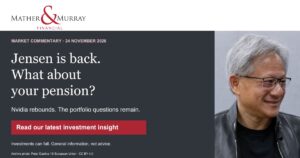
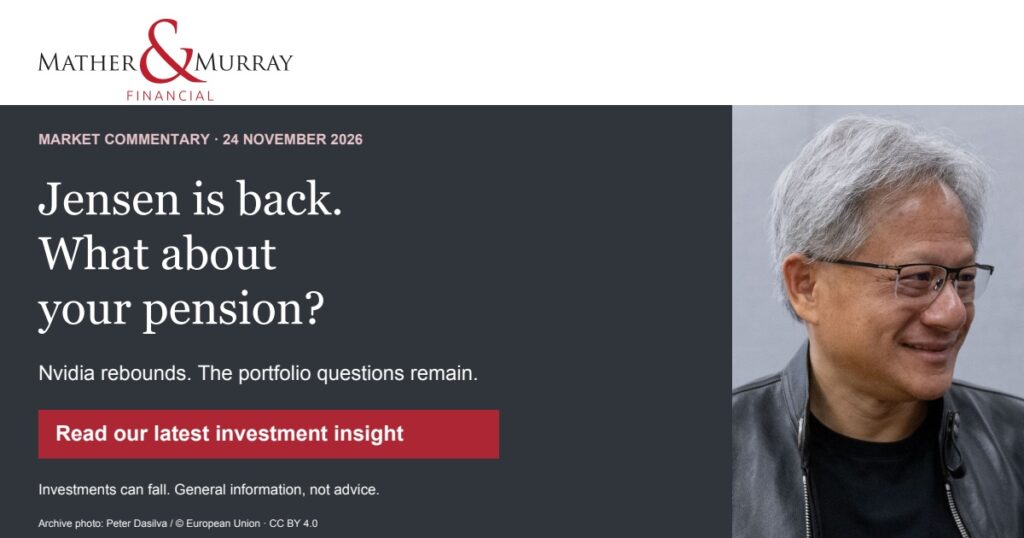
Sources checked 24 November 2026: Nvidia’s reinstatement announcement; Reuters’ 23 November market report; FCA InvestSmart guidance linked above. The photograph is an archive image from 13 May 2024, not the reinstatement event. Photo: Peter Dasilva / © European Union, via Wikimedia Commons, CC BY 4.0. Layout and resizing by Mather & Murray Financial. No endorsement is implied.

By Sam Mather-Holgate
November 24, 2026