Can I Give My House to My Children to Avoid Inheritance Tax?
By Samuel Mather-Holgate · Published 30 October 2026
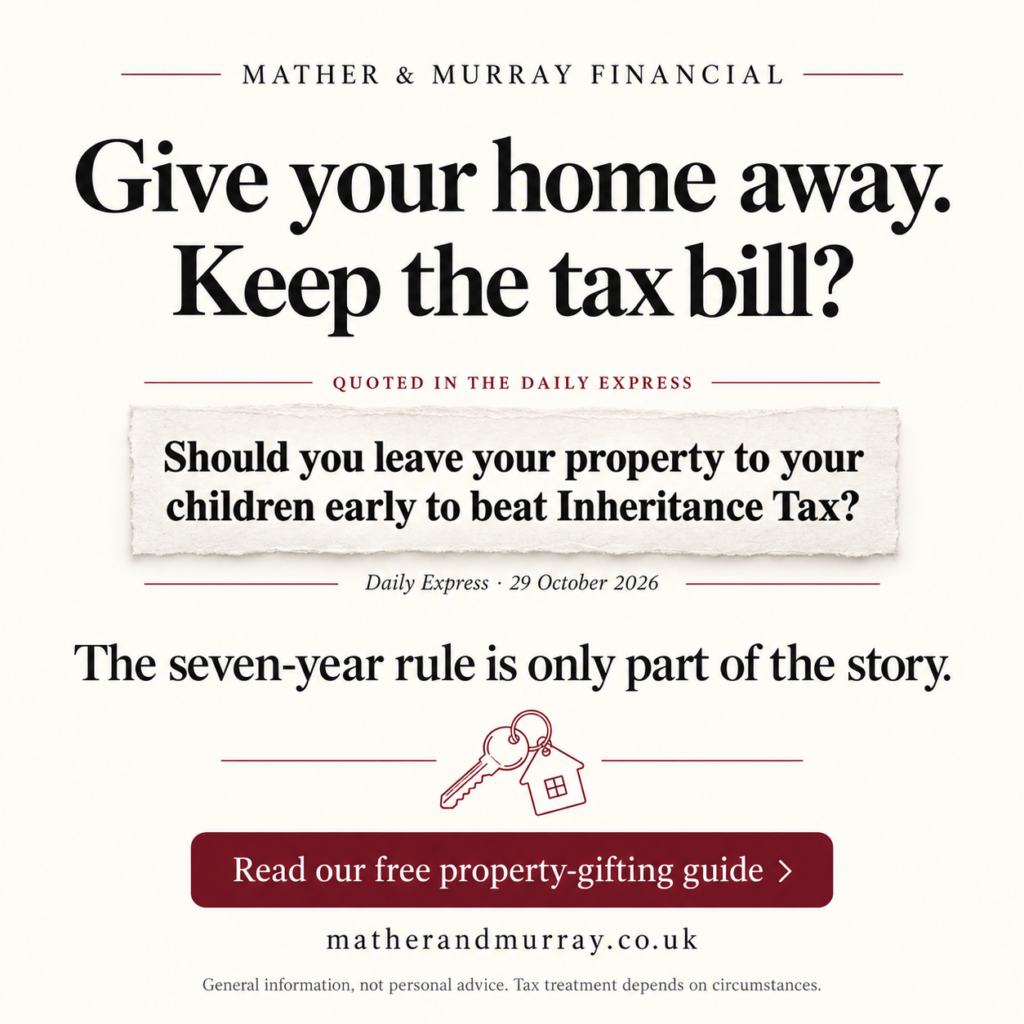
Giving your house to your children does not automatically remove it from your estate for Inheritance Tax (IHT). If you carry on living there rent-free, the property can still count when your estate is assessed, even if you survive for more than seven years. And tax is only one part of the decision: you are also giving up ownership of your home.
The short answer
A genuine outright gift can form part of estate planning in appropriate circumstances. But transferring the deeds is not a simple tax shortcut. Before making a gift, establish whether your estate is likely to face IHT, whether you can afford to lose the asset and what the tax, legal and practical consequences would be.
Thinking about gifting your home? Talk to us before transferring ownership. Start with a free initial phone conversation with our new business team; any further advice and fees will be explained separately.
Does the seven-year rule mean my house will be tax-free?
For an outright gift to an individual, surviving seven years can generally take the gift outside IHT, provided you have not retained a benefit and the relevant conditions are met. Gifts within seven years of death may need to be considered when calculating tax. Taper relief can reduce tax on certain gifts; it does not simply reduce the value of every gift after three years.
HMRC explains the rules on gifts and the seven-year rule. These rules are different from the rules used for care-fee assessments.
Can I give my house to my children and still live in it?
Continuing to occupy the home without paying an appropriate market rent will generally mean you have kept a benefit. The property can then remain within your estate under the gift-with-reservation rules. Waiting seven years does not fix that arrangement.
Paying a genuine market rent and your share of bills may address that particular issue, but requires careful advice and ongoing arrangements. There are limited exceptions, including some situations where a share is gifted and the new owner lives there too. Do not assume your own arrangement qualifies.
Example: A parent transfers their home to an adult child, stays there rent-free and lives for another ten years. The passage of time alone does not mean the property escapes IHT.
See HMRC’s guidance on passing on a home.
Does gifting a house protect it from care fees?
There is no automatic seven-year safe period for care-fee planning. In England, a council may consider whether avoiding care charges was a significant motivation for giving assets away, and what care needs and costs you could reasonably have anticipated at the time. If it finds deliberate deprivation, it may assess you as though you still had the asset. This is not an automatic outcome for every gift.
Care charging rules differ across the UK. Get advice relevant to where you live. The Care and Support Statutory Guidance, Annex E explains the approach in England.
What other taxes and costs should I check?
- Capital Gains Tax: A gift can be treated as a disposal at market value. A qualifying main home may benefit from Private Residence Relief; a second home or rental property can have a different result. There may be a bill despite no sale proceeds being received.
- Tax on rent: If your child becomes your landlord, rental income may create tax obligations for them.
- Property transaction taxes: The treatment depends on the UK nation and whether payment, mortgage debt or other consideration is involved. A solicitor should check this before a transfer.
- Professional and ongoing costs: Legal fees, valuations, lender consent and the affordability of any ongoing rent all matter.
Read HMRC’s guidance on market value when a property is gifted and Private Residence Relief.
What happens if my child divorces, dies or has money problems?
Once ownership changes, you no longer have the same control. Your child’s divorce, insolvency, creditors or death may affect the property and your position. Family relationships and intentions can also change. A promise that you can always stay is not a substitute for understanding your legal rights.
Ask a solicitor how your occupation, any co-ownership and the child’s will would work. Consider what happens if you need to move, fund care, release capital or change your plans. A tax saving is not useful if it undermines your own financial security.
Would keeping the house necessarily mean paying IHT?
Not necessarily. The estate’s available allowances, liabilities, previous gifts and beneficiaries all affect the calculation. A residence nil-rate band may apply when a qualifying home passes to direct descendants, but eligibility and estate-value taper rules matter. There are also rules that may preserve an allowance after qualifying downsizing, sale or gifting.
Start with an estate assessment rather than assuming a valuable home creates a tax bill. HMRC explains the residence nil-rate band and downsizing and gifting provisions.
Seven questions to answer before gifting property
- What is the objective? Helping children now, reducing a possible tax bill and planning for care are different goals.
- Is there likely to be IHT? Review the whole estate, available allowances, debts, wills and earlier gifts.
- Can I afford the gift? Allow for retirement income, inflation, possible care costs and unexpected spending.
- Will I still benefit from the property? Discuss residence, rent and any shared occupation with appropriate specialists.
- What taxes and costs arise now and later? Include the recipient’s position as well as your own.
- What protects my housing security? Understand ownership rights and what happens if family circumstances change.
- Are there more suitable options? Review wills, affordable gifting of other assets, retirement planning and appropriate protection before making an irreversible transfer.
How Mather & Murray Financial can help
We help families understand their financial position, assess affordability and consider inheritance planning as part of a wider plan. Where a property transfer raises legal or specialist tax questions, we work alongside your solicitor or tax adviser as appropriate. We will explain the scope and cost of any further advice before you proceed.
Our head office is in Cricklade, between Swindon and Cirencester, and we support clients across the UK. Explore our inheritance tax planning service, wills guidance and retirement planning.
Ask about inheritance tax and family wealth planning, or call 01793 261626. Your initial call is with our new business team and is not a personal tax or legal recommendation.
Property gifting: frequently asked questions
Can I sell my house to my child for £1?
A nominal price does not remove the need to assess the gift, tax and legal consequences. Discuss the transaction’s substance and market value with your advisers before signing anything.
Can a trust solve the problem?
A trust is not a universal workaround. It can involve setup and ongoing tax charges, legal costs and restrictions. Retaining a benefit can still matter. Suitability depends on the arrangement and your circumstances.
Should my children join the conversation?
Often it helps to discuss intentions, affordability and responsibilities together, while ensuring you receive advice that protects your own interests. Everyone should understand that a gift changes ownership and can affect their finances.
Do I need to subscribe to the Express to read this guide?
No. This is MMF’s original, free explanation. The linked newspaper article is separate and may require a subscription.
General information as at 30 October 2026, not personalised financial, tax or legal advice. Tax treatment depends on individual circumstances and rules can change. Property transfers require appropriate legal advice. The Express mention is editorial coverage, not an endorsement of MMF’s services.
Put this into your own financial plan.
Consider family wealth as a whole before giving away assets. AIM is a higher-risk investment option, not a substitute for protecting your own housing and financial security.
Ask about your investment and family wealth planning
Start with a free phone conversation with our new business team. A separate adviser appointment, the work proposed and any advice fees are explained before you commit. An enquiry does not instruct a transfer or investment.
Investment values can fall as well as rise. Tax treatment depends on circumstances and may change. Explore all our Wealth advice services.

By Sam Mather-Holgate
October 30, 2026